

Cannabis Entourage Effect Explained: What You Need to Know
The cannabis entourage effect is defined as the theory that cannabinoids, terpenes, and flavonoids in cannabis work together to produce stronger or different therapeutic effects than any single compound alone. You’ve probably seen this term on product labels or heard it from budtenders, but the science behind it is more nuanced than most marketing suggests. Understanding what the entourage effect actually means, and what it doesn’t, helps you make smarter choices about the cannabis products you use. At Tghhouston, we believe informed customers get the most out of every experience.
What is the cannabis entourage effect?
The cannabis entourage effect is a hypothesis, not a proven law. The term itself has an interesting origin. The original 1998 paper by Ben-Shabat et al. described inactive lipids enhancing the activity of 2-arachidonoylglycerol, an endogenous cannabinoid in the human body. It was not originally about whole-plant cannabis synergy at all. The concept was later extended to describe how cannabis compounds like THC, CBD, terpenes, and flavonoids might interact to shape the overall effect of a product.
The core idea is that cannabis contains hundreds of active compounds. THC is the primary psychoactive cannabinoid. CBD is non-intoxicating and has well-documented effects on seizure disorders and anxiety. Terpenes are aromatic compounds like myrcene, limonene, and caryophyllene that give cannabis its distinct smell and flavor. Flavonoids are a lesser-studied group of plant compounds with potential anti-inflammatory properties. The entourage effect proposes that these compounds amplify or modify each other’s effects when consumed together, rather than acting in isolation.
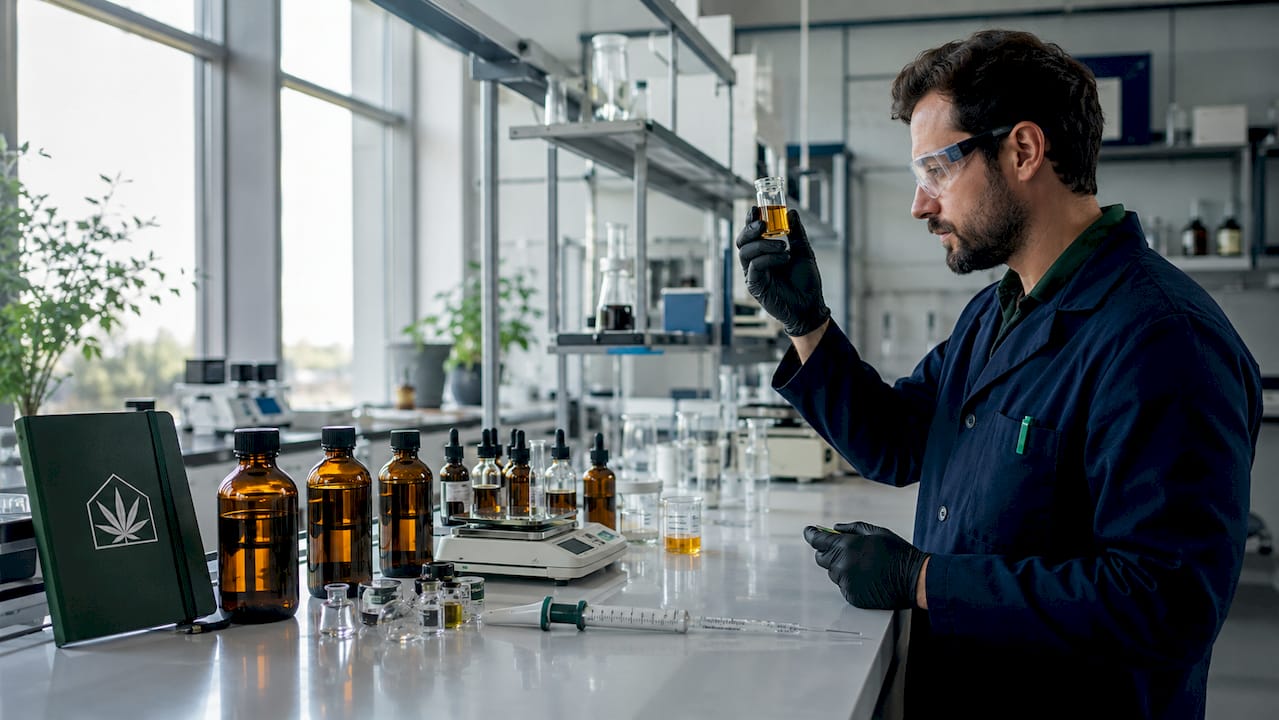
Understanding the types of cannabinoids involved is the first step toward understanding why this synergy matters. The cannabis plant produces over 100 known cannabinoids, and each one interacts with the body’s endocannabinoid system differently.
What does the science actually say?
The scientific evidence for the entourage effect is real but uneven. THC and CBD interaction has the strongest clinical support. A 2017 study showed 38.9% seizure reduction using CBD compared to 13.3% for placebo. That result shows isolates can still be highly effective on their own, which challenges the idea that whole-plant formulas are always superior.
Terpene-cannabinoid synergy has newer and more exciting data. A June 2026 in-vitro study found that specific terpene-THC mixtures produced several-fold amplification of CB1 receptor activation at natural terpene-to-THC ratios. That’s a significant finding. It means the ratio of compounds matters as much as the presence of any single compound.
Here’s what the current research supports and where it falls short:
- THC and CBD synergy: Supported by clinical epilepsy and pain studies. CBD can modulate THC’s psychoactive intensity, and the combination shows benefits beyond either compound alone.
- Terpene contributions: A 2024 double-blind trial showed limonene reduces THC-induced paranoia, which is a concrete example of a specific terpene shaping the cannabis experience.
- Pharmacokinetic interactions: High-dose CBD can increase THC’s psychoactive impact by inhibiting liver enzymes. This is a pharmacokinetic interaction, meaning it changes how the body processes compounds, not just how they act at receptors.
- Pharmacodynamic interactions: These involve compounds acting on the same receptors or pathways simultaneously. This type of interaction is harder to study and less well-documented.
- Gaps in the research: Experts consistently call for more randomized controlled trials. Most terpene-cannabinoid synergy data comes from preclinical or in-vitro studies, not human clinical trials.
The honest takeaway is that the entourage effect is a promising but unproven hypothesis. No universal formula exists for predicting which compound combinations will produce which effects.
How do cannabinoids, terpenes, and flavonoids each contribute?
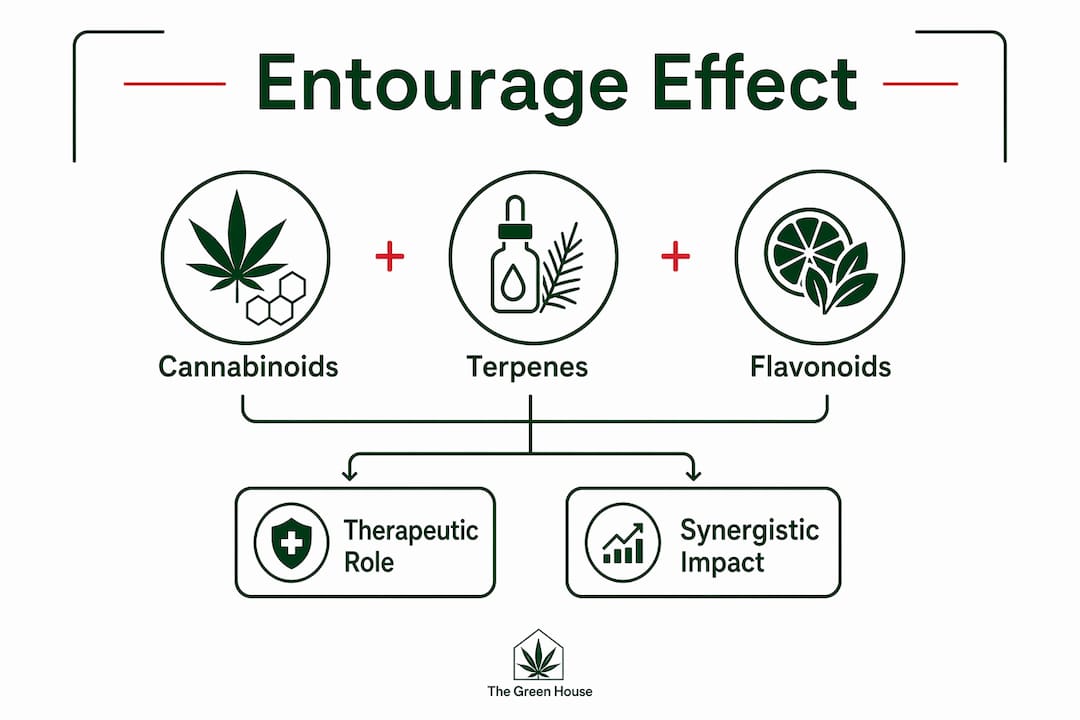
Each class of cannabis compound plays a different role in the overall therapeutic profile of a product. Understanding these roles helps you read product labels with more confidence.
| Compound Type | Primary Mechanism | Key Examples | Receptor Targets |
|---|---|---|---|
| Cannabinoids | Direct CB1/CB2 receptor binding | THC, CBD, CBG, CBN | CB1, CB2 |
| Terpenes | Non-cannabinoid receptor pathways | Limonene, myrcene, caryophyllene | Adenosine A2A, TRP channels |
| Flavonoids | Anti-inflammatory and antioxidant activity | Cannflavin A, quercetin | Multiple, still under study |
THC binds directly to CB1 receptors in the brain, producing psychoactive effects. CBD has a more complex pharmacology. It does not bind strongly to CB1 or CB2 receptors but influences them indirectly and acts on serotonin and vanilloid receptors. This is part of why THCA vs CBD differences matter so much when choosing a product.
Terpenes work through entirely different pathways. Research by LaVigne et al. published in Scientific Reports found no evidence terpenes modulate CB1/CB2 receptors directly. Instead, terpenes like caryophyllene act on adenosine A2A receptors, and others act on TRP channels involved in pain signaling. This means terpenes add to the overall effect through separate, additive pathways rather than boosting THC at the cannabinoid receptor. Learning how terpenes shape your experience is genuinely useful for product selection.
Flavonoids are the least studied of the three. Cannflavin A and cannflavin B, unique to the cannabis plant, show anti-inflammatory activity in early research. Their contribution to the entourage effect is real but not yet well-characterized.
Why do indica and sativa labels mislead you?
Strain labels like “indica” and “sativa” do not reliably predict the entourage effect or therapeutic outcomes. This is one of the most persistent misconceptions in cannabis culture, and the scientific consensus is clear on it.
There is no clinical evidence that indica or sativa labels reliably predict the chemical profile or effects of a product. Two products sold as the same strain can have dramatically different terpene and cannabinoid concentrations depending on the grower, growing conditions, and harvest timing. The label tells you almost nothing about what’s actually in the product.
Here’s what actually matters instead:
- Cannabinoid percentages: Look for the actual THC and CBD content, not just the strain name.
- Terpene profiles: Specific terpenes like caryophyllene and limonene contribute distinct effects when combined with cannabinoids in dose-dependent ways.
- Full-spectrum vs. isolate: Full-spectrum products preserve more of the plant’s chemical diversity. Isolates contain a single purified compound.
- Certificate of Analysis (COA): A lab-verified document showing the actual chemical content of the product.
Understanding cannabis cultivar differences gives you a much more accurate picture than any strain name. The industry is slowly moving toward cultivar-based labeling that reflects actual chemical profiles.
Pro Tip: When shopping, ask for or look up the COA for any product. A good COA lists both cannabinoid percentages and terpene content, giving you real data to work with instead of a marketing label.
How to use the entourage effect practically
Applying the entourage effect to your actual cannabis choices comes down to a few concrete habits. Here’s a practical framework:
-
Read the COA before you buy. A cannabis certificate of analysis tells you the exact cannabinoid and terpene percentages in a product. This is the single most useful document for understanding what you’re consuming.
-
Choose full-spectrum over isolate when synergy is your goal. Full-spectrum products contain the full range of cannabinoids and terpenes from the plant. Isolates contain one compound. Full-spectrum means chemical diversity, not necessarily stronger effects. Dosage and ratios critically influence outcomes.
-
Consider your consumption method. Entourage interactions depend heavily on the route of administration. Liver enzymes modulate compound interactions, resulting in different effects for inhaled versus ingested cannabis. Edibles pass through the liver first, which changes how THC and CBD interact. Inhalation delivers compounds more directly to the bloodstream.
-
Start with lower doses. Because compound interactions are dose-dependent, a lower dose of a full-spectrum product may produce a different effect than a high dose of the same product. High-dose CBD, for example, can alter THC metabolism in ways that increase psychoactive intensity.
-
Be skeptical of marketing claims. Marketing often overstates whole-plant superiority. More compounds do not automatically mean better effects. The entourage effect is real in some contexts and irrelevant in others.
-
Talk to a healthcare provider. If you’re using cannabis for a specific health condition, a provider familiar with cannabis medicine can help you think through compound ratios and dosing strategies.
Pro Tip: If you’re exploring the role of terpenes in cannabis drinks, look for products that list specific terpene content on the label. Vague terms like “natural flavors” tell you nothing about the actual terpene profile.
Key Takeaways
The cannabis entourage effect is a scientifically supported but not fully proven hypothesis that requires attention to compound ratios, consumption method, and product quality to apply meaningfully.
| Point | Details |
|---|---|
| Entourage effect defined | Cannabis compounds work together synergistically, but no universal formula predicts the outcome. |
| THC-CBD synergy is best supported | Clinical studies show CBD modulates THC effects and has independent therapeutic value. |
| Terpenes act via separate pathways | Terpenes like limonene and caryophyllene work through non-cannabinoid receptors, not CB1/CB2. |
| Strain labels are unreliable | Indica and sativa labels do not predict chemical profiles; always check the COA instead. |
| Consumption method changes everything | Inhaled and ingested cannabis produce different compound interactions due to liver metabolism. |
My honest take on the entourage effect
The entourage effect is one of the most misunderstood concepts in cannabis. I’ve seen it used to justify everything from premium pricing to unsubstantiated health claims. The truth is more interesting and more useful than the marketing version.
The science is real. Specific terpene-cannabinoid combinations do produce measurable differences in receptor activity and subjective experience. The limonene-THC paranoia study is a good example of the kind of precise, compound-specific research that actually moves this field forward. But the idea that “more compounds always equals better effects” is not supported by the evidence. The 2017 CBD epilepsy data proves isolates can be highly effective.
What I find most useful is thinking about the entourage effect as a reason to pay attention to chemistry, not as a guarantee of any particular outcome. Full-spectrum products give you more variables to work with. That’s valuable if you understand what those variables are. It’s noise if you don’t. The COA is your best tool. Use it every time.
— Ethan
Tghhouston’s full-spectrum products worth trying
At Tghhouston, we stock lab-tested products with clear chemical profiles so you can actually apply what you’ve learned about cannabis synergy.
If you want a measured, full-spectrum experience, the THCA Seltzer Single Cans are a great starting point. Each can delivers a consistent dose in a format that’s easy to track. For gummy fans, Wyld Gummies 10ct offer well-defined cannabinoid profiles that make dosing straightforward. Both products come with lab verification so you know exactly what you’re getting. Our menu rotates daily to keep things fresh, and we offer free delivery on orders over $100. Stop by our EaDo or Spring Branch locations anytime, 24/7.
FAQ
What is the cannabis entourage effect in simple terms?
The cannabis entourage effect is the theory that cannabinoids, terpenes, and flavonoids in cannabis work better together than any single compound alone. It’s a hypothesis with growing scientific support, not a proven fact.
Does the entourage effect mean full-spectrum is always better?
Full-spectrum products offer more chemical diversity, but isolates have strong clinical evidence in specific contexts, like CBD for epilepsy. Better depends on your goal and the specific compounds involved.
How do terpenes contribute to the entourage effect?
Terpenes like limonene and caryophyllene act through non-cannabinoid receptors such as adenosine A2A and TRP channels, adding effects through separate pathways rather than boosting THC directly at CB1 receptors.
Does the consumption method affect the entourage effect?
Yes. Inhaled cannabis delivers compounds directly to the bloodstream, while edibles pass through the liver first. Liver enzymes change how cannabinoids interact, producing different effects from the same product.
How do I know if a product supports the entourage effect?
Check the certificate of analysis for both cannabinoid percentages and terpene content. Products with a full terpene profile and multiple cannabinoids present the best conditions for compound synergy.
Recommended
Before You Go…
Here are a few handpicked articles to inspire your next self-care moment.


