

Cannabis Anti-Inflammatory Property: What You Need to Know
Cannabis is defined as a plant with documented anti-inflammatory properties, meaning its bioactive compounds actively regulate the body’s inflammatory response at the molecular level. The scientific term for this activity is “immunomodulation,” and it covers a wide range of effects from suppressing pro-inflammatory cytokines to activating specific immune receptors. These effects come from both cannabinoids like CBD and THC and non-cannabinoid compounds like prenylated flavonoids. Research into what is cannabis anti-inflammatory property has expanded significantly in recent years, with preclinical and early clinical studies pointing to multiple overlapping mechanisms. We’re breaking it all down here so you can make sense of the science without needing a medical degree.
How do cannabinoids in cannabis reduce inflammation?
The endocannabinoid system is the primary gateway through which cannabis compounds influence inflammation. It contains two key receptor types: CB1 receptors, found mainly in the brain and nervous system, and CB2 receptors, concentrated in immune tissues. CB2 receptor activation suppresses pro-inflammatory cytokines like IL-1β, IL-6, and TNF-α while promoting anti-inflammatory mediators like IL-10 and TGF-β. That shift in cytokine balance is a core part of how cannabis reduces inflammation at the cellular level.
CBD is the most studied cannabinoid for anti-inflammatory purposes. CBD lowers pro-inflammatory cytokines, inhibits T cell migration and adhesion, and triggers T cell apoptosis, which is the process of programmed cell death that limits immune overactivation. This makes CBD particularly relevant for conditions where the immune system is overreacting. You can learn more about how different cannabinoids compare in terms of effects by checking out this THCA vs CBD breakdown from Tghhouston.

THC also shows anti-inflammatory activity, primarily through CB1 and CB2 receptor binding. However, its psychoactive effects mean it requires more careful consideration, especially for people who need to stay clear-headed during the day.
Minor cannabinoids are an emerging area of interest. Here’s what the current research shows:
- CBN (cannabinol): Shows anti-inflammatory effects in preclinical models by reducing paw edema and pro-inflammatory cytokines.
- CBL (cannabicyclol): Demonstrates similar effects at high doses in animal studies.
- Therapeutic window concern: CBN and CBL at 100 mg/kg reduced inflammation in preclinical models, but both caused side effects including hypothermia and altered movement. Even at 50 mg/kg, side effects appeared.
- Clinical gap: No large human trials yet confirm these effects translate safely to people.
Pro Tip: If you’re curious about which cannabinoids are in a specific product, look for a certificate of analysis (COA). Tghhouston provides lab-tested products so you always know what you’re getting.
What role do non-cannabinoid compounds play in cannabis anti-inflammatory effects?
Cannabis contains far more than just cannabinoids. Its non-cannabinoid compounds, particularly phenolics and flavonoids, contribute meaningfully to its anti-inflammatory activity, sometimes through entirely different pathways.
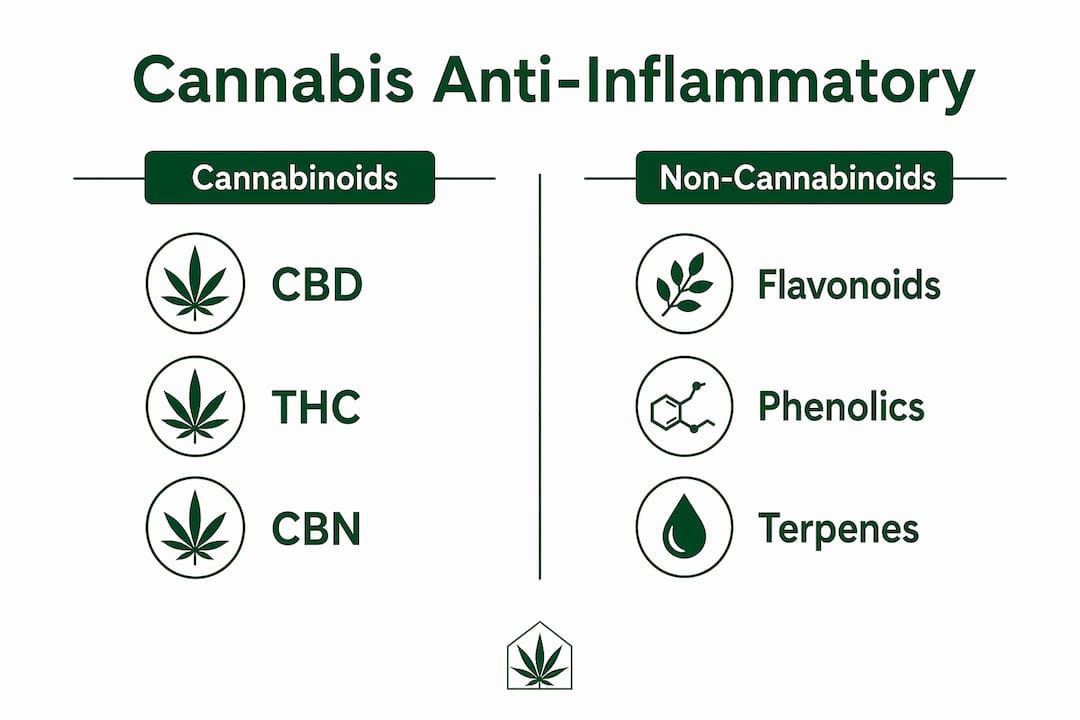
The most notable examples are prenylated flavonoids called cannflavins. Cannflavins inhibit mPGES-1 and 5-LOX, two enzymes that drive eicosanoid-mediated inflammation. Eicosanoids are signaling molecules that amplify the inflammatory response, so blocking their production at the enzyme level is a direct and potent anti-inflammatory action. This mechanism is entirely separate from CB1 or CB2 receptor activation.
The research on cannabinoid-free extracts makes this even clearer:
- Gene expression suppression: Cannabinoid-free Cannabis sativa extracts suppress inflammatory gene expression by 42–66% in intestinal inflammation models. That’s a significant reduction driven purely by non-cannabinoid phenolic compounds.
- Cytokine targeting: These extracts specifically reduced IL-1β, IL-6, and COX2 activity, the same inflammatory markers targeted by many pharmaceutical anti-inflammatory drugs.
- ERK pathway modulation: Cannabis root extract suppresses ERK phosphorylation and increases 2-AG levels through endocannabinoid system modulation, without significantly affecting NF-κB signaling. This points to a distinct, receptor-adjacent pathway.
- Entourage effect: When cannabinoids and non-cannabinoid compounds work together, their combined anti-inflammatory effect appears stronger than either group alone. This synergy is often called the “entourage effect.”
| Compound type | Primary mechanism | Receptor dependence |
|---|---|---|
| CBD, THC | Cytokine suppression, T cell modulation | CB1/CB2 dependent |
| Cannflavins | mPGES-1 and 5-LOX enzyme inhibition | Receptor independent |
| Root extract phenolics | ERK suppression, 2-AG elevation | Partially receptor mediated |
| Cannabinoid-free extracts | IL-1β, IL-6, COX2 gene suppression | Receptor independent |
This table shows why full-spectrum products, which preserve both cannabinoid and non-cannabinoid compounds, tend to be favored in wellness contexts. The science on CBD’s wellness applications, including its safety profile, is covered well in this CBD for wellness guide from Elevated Remedies.
What are the complexities of cannabis anti-inflammatory activity?
Cannabis does not work the same way for everyone. Its immune effects depend heavily on dose, individual physiology, and existing health conditions. This is one of the most important things to understand before using cannabis for inflammation-related purposes.
The most striking example is CBD’s paradoxical immune behavior. CBD can upregulate some inflammatory cytokines like IL-6 while simultaneously downregulating others. That dual effect means CBD acts as both an anti-inflammatory and a pro-inflammatory agent depending on context. For most healthy people, the net effect leans anti-inflammatory. For people on immunosuppressants, the picture gets more complicated.
Here are the key complexities you should know about:
- Dose dependency: Low doses and high doses of the same cannabinoid can produce opposite immune effects. There is no universal “right dose” for inflammation.
- Drug interactions: CBD affects liver enzymes that metabolize many common medications. People taking blood thinners, anti-seizure drugs, or immunosuppressants need medical guidance before adding cannabis.
- Immunocompromised individuals: Cannabis can alter immune function in ways that may not be safe for people with autoimmune conditions or those on immune-modifying therapies.
- Research limitations: Large randomized clinical trials are limited. Most evidence comes from observational studies, animal models, and small human trials. That gap matters when drawing conclusions about specific conditions.
- Multi-receptor signaling: Cannabis anti-inflammatory action involves TRP channels, PPAR-γ, and orphan GPCRs beyond CB1 and CB2. This complexity makes predicting individual responses difficult.
Pro Tip: Always consult a healthcare provider before using cannabis products if you take prescription medications or have an immune-related condition. The science is promising, but personalized guidance matters.
Practical considerations for using cannabis for inflammation
Understanding the science is one thing. Knowing how to approach cannabis products responsibly is another. Here’s what to keep in mind if you’re exploring cannabis for its anti-inflammatory potential.
Product type makes a real difference. Full-spectrum extracts preserve cannabinoids, flavonoids, and other plant compounds together, which supports the entourage effect. Isolated cannabinoids like pure CBD offer more predictable dosing but may miss synergistic benefits. Minor cannabinoid products are still early-stage and require caution given their narrow therapeutic window in preclinical data. You can explore the full range of cannabinoid types and effects on the Tghhouston blog.
Key practical points to consider:
- Start low, go slow: Begin with the lowest effective dose and adjust gradually. This applies to gummies, tinctures, and any other format.
- Prioritize lab-tested products: A certificate of analysis confirms cannabinoid content and rules out contaminants. Learn what to look for in a cannabis COA before you buy.
- Know your format: Edibles like gummies have a slower onset than vapes or tinctures. Onset time affects how you gauge dosage.
- Research areas to watch: Autoimmune conditions and gut inflammation are active research areas where cannabis anti-inflammatory effects show early promise, though clinical confirmation is still developing.
- Legal context: Cannabis regulations vary by state and product type. THCA products occupy a specific legal category. Always buy from a licensed, compliant source.
Cannabis and its interaction with body systems, including how it supports physical relaxation, is explained further in this cannabis body relaxation guide from Tghhouston.
Key Takeaways
Cannabis anti-inflammatory properties operate through multiple overlapping mechanisms, including cannabinoid receptor activation, non-cannabinoid enzyme inhibition, and synergistic compound interactions, making product quality and informed use critical.
| Point | Details |
|---|---|
| CB2 receptors drive key effects | CB2 activation suppresses IL-1β, IL-6, and TNF-α while promoting anti-inflammatory mediators. |
| Non-cannabinoid compounds matter | Cannabinoid-free extracts suppress inflammatory gene expression by 42–66% through phenolic compounds. |
| CBD has paradoxical effects | CBD can both raise and lower specific cytokines, requiring careful use in medicated individuals. |
| Minor cannabinoids need caution | CBN and CBL show preclinical promise but cause side effects at effective doses. |
| Full-spectrum products leverage synergy | Combining cannabinoids with flavonoids and plant phenolics amplifies anti-inflammatory activity. |
The science is real, but the nuance matters more
I’ve spent a lot of time reading through cannabis research, and the thing that strikes me most is how often the conversation skips the nuance. People hear “anti-inflammatory” and assume cannabis is a straightforward solution for any inflammation-related issue. The biology tells a more interesting story.
What genuinely excites me is the multi-target mechanism. Most pharmaceutical anti-inflammatories hit one pathway. Cannabis compounds hit several simultaneously, including CB1/CB2 receptors, TRP channels, PPAR-γ, and enzyme targets like mPGES-1. That breadth is why researchers are looking at cannabis for complex conditions where single-target drugs fall short. The multi-target modulation angle is genuinely novel and underreported in mainstream coverage.
What I’d caution against is treating preclinical data as clinical proof. Animal models showing 42–66% gene suppression are compelling. They are not the same as a large human trial. The honest position is that cannabis shows strong mechanistic evidence for anti-inflammatory activity, and the clinical picture is still catching up.
My practical takeaway: if you’re interested in cannabis for inflammation, focus on product quality, start conservatively, and stay in conversation with your doctor. The science supports curiosity. It doesn’t yet support replacing prescribed treatment without professional input.
— Ethan
Quality cannabis products worth exploring at Tghhouston
If you’re curious about cannabis for its anti-inflammatory potential, product quality is everything. Tghhouston carries a curated selection of lab-tested THCA products at both Houston locations, available 24/7 with free delivery on orders over $100.

For an easy entry point, Wyld Gummies are a popular choice with consistent dosing and clear labeling. If you prefer a beverage format, THCA seltzer cans offer a refreshing and measured way to explore cannabinoid effects. Every product at Tghhouston comes with transparent lab results, so you always know exactly what’s in what you’re consuming. That transparency is the foundation of responsible use.
FAQ
What is the cannabis anti-inflammatory property?
The cannabis anti-inflammatory property refers to the ability of cannabis compounds, including cannabinoids like CBD and THC and non-cannabinoid flavonoids like cannflavins, to suppress pro-inflammatory cytokines and modulate immune cell activity. These effects occur through multiple pathways including CB2 receptor activation and enzyme inhibition.
Does CBD actually relieve inflammation?
CBD reduces pro-inflammatory cytokines, inhibits T cell proliferation, and induces T cell apoptosis, all of which contribute to lower inflammatory activity. However, CBD can also upregulate certain cytokines like IL-6 in some contexts, so effects depend on dose and individual physiology.
What makes cannabis anti-inflammatory beyond just cannabinoids?
Non-cannabinoid compounds like prenylated flavonoids (cannflavins) inhibit inflammatory enzymes mPGES-1 and 5-LOX independently of cannabinoid receptors. Cannabinoid-free cannabis extracts have also shown 42–66% suppression of inflammatory gene expression in preclinical models.
Are minor cannabinoids like CBN good for inflammation?
CBN and CBL show anti-inflammatory effects in preclinical studies, reducing paw edema and cytokine levels. Both require high doses that also cause side effects like hypothermia, so their therapeutic use in humans needs further research and professional oversight.
Is cannabis a proven treatment for chronic inflammation?
Cannabis shows strong mechanistic and preclinical evidence for anti-inflammatory activity, but large randomized clinical trials in humans remain limited. Current evidence relies heavily on observational studies and small trials, meaning cannabis should be considered a supportive option rather than a confirmed treatment without medical guidance.
Recommended
Before You Go…
Here are a few handpicked articles to inspire your next self-care moment.


