

The Role of Cannabinoid Synergy in Therapeutic Cannabis
Cannabinoid synergy is defined as the cooperative interaction between cannabinoids and terpenes that produces therapeutic effects greater than any single compound alone. This is the core principle behind what researchers call the entourage effect. Cannabinoids like THC and CBD work through receptors CB1 and CB2, while terpenes like linalool and beta-caryophyllene amplify those effects through complementary biological pathways. The role of cannabinoid synergy matters most when you’re choosing cannabis for pain, anxiety, or inflammation, because isolated compounds consistently underperform compared to full-spectrum formulations. Science in 2026 is moving fast on this, and we want to help you cut through the noise.
How do cannabinoids and terpenes interact biologically to produce synergy?
Cannabinoid synergy starts at the receptor level. THC binds directly to CB1 receptors in the brain and nervous system, producing psychoactive and analgesic effects. CBD modulates the CB1 receptor by changing its shape without blocking it, which shifts how THC behaves rather than simply canceling it out. That distinction matters because it means CBD and THC are not opposites. They’re partners.
Terpenes add another layer. All tested cannabis terpenes activate CB1 receptors at 10–50% of THC’s effect, and some terpene-THC combinations increase CB1 activation several fold. That’s not a small bump. That’s a meaningful amplification of the same receptor THC targets.

Beta-caryophyllene goes even further. It binds directly to CB2 receptors, acting as a dietary cannabinoid and boosting anti-inflammatory effects through a pathway THC doesn’t use. Linalool, the terpene responsible for lavender’s calming scent, works through serotonin and adenosine pathways rather than cannabinoid receptors at all. These are additive effects, not redundant ones.
Pharmacokinetics also play a role. THC combined with myrcene produced 22% higher THC plasma levels than THC alone, suggesting myrcene slows THC metabolism and extends its window of effect. That’s a pharmacokinetic interaction, not just a receptor story.
- CB1 and CB2 activation: THC targets CB1; beta-caryophyllene targets CB2 independently
- Terpene amplification: Certain terpenes multiply CB1 activation several fold when combined with THC
- Independent pathways: Linalool and other terpenes act on serotonin and adenosine receptors, adding effects without overlap
- Pharmacokinetic shifts: Myrcene increases THC bioavailability by slowing its breakdown
Pro Tip: When reading a terpene profile, look for beta-caryophyllene and linalool specifically. These two have the strongest evidence for complementary receptor activity alongside cannabinoids.
What clinical evidence supports cannabinoid synergy for health conditions?
The clinical picture is genuinely promising, though not without limits. Chronic pain patients using full-spectrum cannabis extract showed better pain reduction and sleep quality than those using CBD isolate over 12 weeks. That’s a head-to-head comparison, not a theoretical claim.
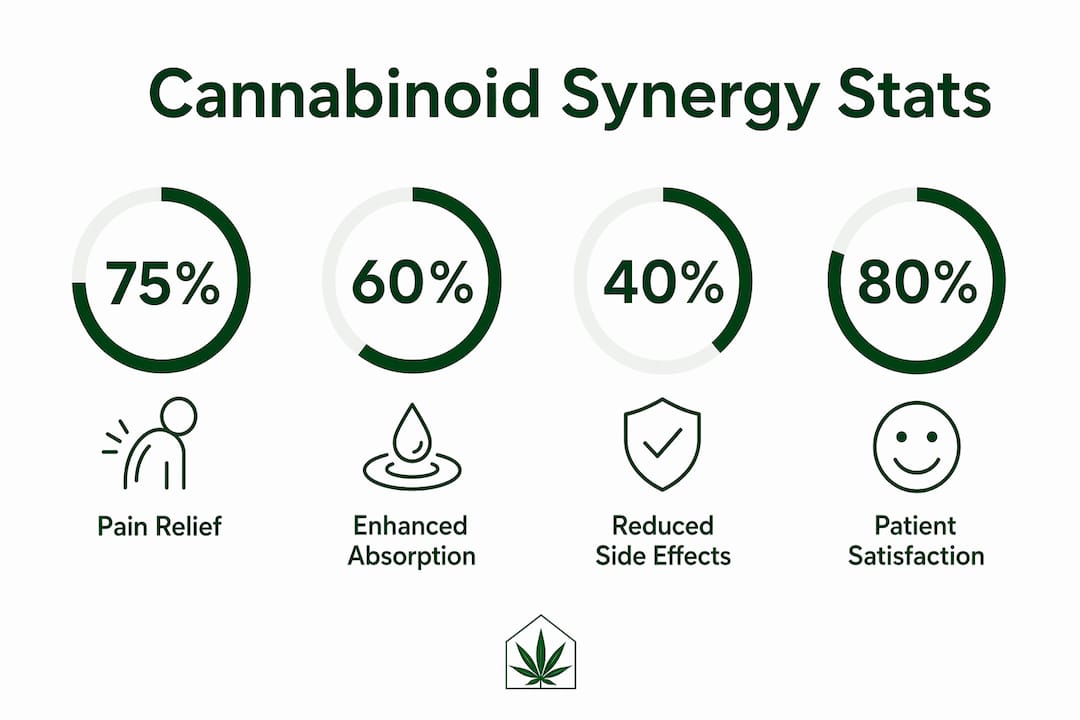
Anxiety research shows a similar pattern. THC combined with limonene produced 34% lower anxiety scores compared to THC alone at equivalent doses. Limonene is the terpene behind citrus aromas, and it appears to counteract THC-induced anxiety through serotonin receptor activity. For people who find THC too stimulating, this pairing is worth knowing.
| Condition | Isolated compound | Full-spectrum / targeted pairing | Observed advantage |
|---|---|---|---|
| Chronic pain | CBD isolate | Full-spectrum extract | Better pain reduction and sleep quality |
| Anxiety | THC alone | THC + limonene | 34% lower anxiety scores |
| Inflammation | CBD alone | CBD + beta-caryophyllene | Enhanced CB2-mediated anti-inflammatory effect |
| Neuropathic pain | CBD alone | CBD + linalool | Complementary serotonin pathway activity |
“The entourage effect is a productive hypothesis with partial clinical support. Cannabinoid synergy varies by ratio, administration route, and therapeutic target.” — The Cannigma research review
One important caution: CBD is a potent inhibitor of CYP450 enzymes including CYP2C19, CYP2C9, and CYP3A. This affects the metabolism of drugs like midazolam, bupropion, and tramadol. If you take prescription medications, talk to a healthcare provider before adding cannabinoids to your routine. Synergy cuts both ways.
The honest takeaway is that full-spectrum formulations outperform isolates in most studied conditions. But the specific cannabinoid and terpene ratios matter more than simply choosing “full-spectrum” as a label.
How does the entourage effect fit into current scientific understanding?
The entourage effect is the most cited concept in cannabis marketing and one of the most misunderstood in cannabis science. Defined properly, it describes the enhanced therapeutic outcome produced when multiple cannabis compounds work together. The problem is that the term gets stretched to cover everything from mild additive effects to claims of near-miraculous synergy.
The entourage effect is best understood as a promising scientific hypothesis that needs more rigorous randomized controlled trials to clarify its mechanisms and clinical significance. That’s not a dismissal. It’s a call for precision.
Here’s what the science actually supports right now:
- Direct receptor modulation: Some terpenes activate cannabinoid receptors directly, as seen with beta-caryophyllene and CB2.
- Additive independent effects: Terpenes like linalool act on serotonin and adenosine pathways, adding therapeutic value without touching cannabinoid receptors.
- Pharmacokinetic interactions: Compounds like myrcene alter how quickly THC is metabolized, changing its duration and intensity.
- Ratio dependence: The same compounds in different ratios can produce opposite outcomes. High-dose CBD can actually increase THC effects through liver enzyme inhibition.
The marketing version of the entourage effect implies that more plant compounds always means better results. That’s not accurate. Full-spectrum cannabis’s advantage lies in specific composition, not simply including the full plant profile. A poorly formulated full-spectrum product can underperform a well-designed targeted extract.
Pro Tip: Skip the “Indica vs. Sativa” labels entirely. Lab-tested chemical composition predicts therapeutic outcomes far better than strain category. Ask for a certificate of analysis (COA) every time.
How can you apply cannabinoid synergy knowledge when choosing products?
Knowing the science is only useful if it changes what you put in your cart. Here’s how to apply it practically.
Read the COA before you buy. A certificate of analysis shows the exact cannabinoid and terpene ratios in a product. You’re looking for more than just THC percentage. Check for terpene content, especially beta-caryophyllene, linalool, limonene, and myrcene. These four have the strongest evidence for synergistic activity.
Match your terpene profile to your goal:
- Pain and inflammation: Look for beta-caryophyllene and linalool. Both have analgesic and anti-inflammatory properties through complementary pathways.
- Anxiety: Limonene-rich products paired with moderate THC show the strongest evidence for anxiety reduction.
- Sleep: Myrcene-dominant products increase THC bioavailability and sedation. Start low with these.
- General wellness: A broad-spectrum product with a diverse cannabinoid profile covers more receptor pathways simultaneously.
Start with a low dose and titrate slowly. Synergistic effects can be stronger than you expect, especially with myrcene-rich products that raise THC plasma levels. Give each combination at least a week before adjusting. Keep notes on how specific products affect you. Individual response varies more than most product descriptions suggest.
Avoid products that only list THC percentage without terpene data. That’s like buying a meal based only on calorie count. The composition is what drives the outcome.
Key takeaways
Cannabinoid synergy produces measurably better therapeutic outcomes than isolated compounds because specific terpene-cannabinoid combinations activate multiple receptor pathways simultaneously.
| Point | Details |
|---|---|
| Synergy beats isolates | Full-spectrum extracts outperformed CBD isolate for pain and sleep in 12-week clinical comparisons. |
| Terpenes amplify receptors | Certain terpene-THC combinations increase CB1 activation several fold beyond THC alone. |
| Ratios determine outcomes | The same compounds in different ratios can produce opposite effects, so composition matters more than category. |
| COAs over labels | Lab-tested terpene and cannabinoid data predicts therapeutic outcomes better than Indica or Sativa labels. |
| Drug interaction risk | CBD inhibits CYP450 enzymes, affecting metabolism of common prescription drugs. |
Why I think most people are still missing the point on cannabinoid synergy
I’ve spent a lot of time reading the research on cannabinoid interactions, and the gap between what the science says and what most people believe is genuinely frustrating. The entourage effect gets treated like a marketing slogan when it’s actually a nuanced pharmacological concept that requires real attention to detail.
The biggest mistake I see is people choosing full-spectrum products because they’ve heard “full-spectrum is better,” without ever looking at the terpene content. A full-spectrum product with negligible terpene levels isn’t going to deliver meaningful synergy. The advantage comes from specific compounds in meaningful concentrations, not from a label.
What actually works, in my experience, is treating your cannabis choices the way you’d treat any other health decision. Read the COA. Match the terpene profile to your goal. Start low and track your response. The people who get the most out of cannabinoid synergy are the ones who pay attention to what’s actually in their product.
I also think the drug interaction angle gets ignored too often. CBD’s effect on CYP450 enzymes is real and clinically significant. If you’re on any regular medication, that conversation with your doctor isn’t optional. Synergy in the wrong context can mean more of a drug in your system than you intended.
The science is genuinely exciting. But it rewards careful, informed consumers, not impulse buyers chasing the highest THC number on the shelf.
— Ethan
Products at Tghhouston built for real cannabinoid synergy
If you want to experience the synergistic effects of cannabinoids without guessing at what’s in your product, Tghhouston makes that easy. Every product at The Green House Houston is lab-tested, with transparent cannabinoid and terpene data so you know exactly what you’re getting.

For a clean, full-spectrum experience, the THCA Seltzer singles are a great starting point. If gummies are more your style, Wyld Gummies are formulated with known terpene profiles designed to enhance cannabinoid effects for specific wellness goals. Both products are available 24/7 at our EaDo and Spring Branch locations, with free delivery on orders over $100. The menu rotates daily, so freshness is always guaranteed.
FAQ
What is the role of cannabinoid synergy in cannabis?
Cannabinoid synergy describes how cannabinoids and terpenes work together through multiple biological pathways to produce therapeutic effects greater than any single compound alone. This cooperative interaction is the scientific basis for the entourage effect.
Is the entourage effect scientifically proven?
The entourage effect is a well-supported hypothesis with growing clinical evidence, but it is not yet a fully established scientific law. Randomized controlled trials continue to clarify which specific combinations produce the most reliable outcomes.
Does full-spectrum cannabis always work better than isolates?
Full-spectrum cannabis outperforms isolates in most studied conditions, but the advantage depends on specific terpene and cannabinoid composition. A full-spectrum product with low terpene content may not deliver meaningful synergy.
Which terpenes have the strongest evidence for synergy?
Beta-caryophyllene, linalool, limonene, and myrcene have the strongest research support. Beta-caryophyllene binds directly to CB2 receptors, while myrcene increases THC bioavailability by slowing its metabolism.
Can cannabinoid synergy cause drug interactions?
Yes. CBD inhibits CYP450 enzymes including CYP2C19 and CYP3A, which affects the metabolism of drugs like tramadol and midazolam. Anyone taking prescription medications should consult a healthcare provider before using cannabinoid products.
Recommended
Before You Go…
Here are a few handpicked articles to inspire your next self-care moment.


