

Cannabis Serving Size: A Clear Dosage Guide for Beginners
A cannabis serving size is defined as the standardized amount of THC per portion, typically regulated at 5 to 10 mg THC per serving to promote safety and consistency across products. States like Colorado and Washington cap servings at 10 mg THC, while Massachusetts sets the limit at 5.5 mg. Health Canada and U.S. state regulators use these benchmarks to help consumers dose predictably. Understanding what is cannabis serving size is the first step toward responsible, enjoyable use. The key distinction to know right away: a regulatory serving size is not the same as your personal effective dose.
What is cannabis serving size and how is it defined?
A cannabis serving size is a regulator-defined unit of THC content per portion of a product. It is not a suggestion about how much you should feel. It is a standardized label measurement designed to help consumers track intake and compare products accurately.
Most U.S. states and Canada set the standard serving at 10 mg THC. That number exists because regulators needed a consistent unit for labeling, not because 10 mg is the right amount for every person. Your body weight, metabolism, tolerance, and consumption history all affect how 10 mg hits you.
The serving size standard also applies at the package level. Colorado and Washington, for example, cap total THC per package at 100 mg. That means a standard package contains 10 individual servings at 10 mg each. This structure gives you a clear framework for tracking how much you consume across a session or a day.
Understanding the difference between a regulatory serving and a personal dose is what separates a good experience from a rough one. Regulators set the unit. You decide how many units are right for you.
What is the recommended starting dose and why “start low, go slow” matters
The recommended beginner dose is 1–2.5 mg THC. That is well below a single standard serving. Starting that low feels counterintuitive, but it protects you from the most common cannabis mistake: taking too much before you know how your body responds.
The “start low, go slow” principle is backed by medical guidance and practical experience. Here is how to apply it step by step:
- Start at 1–2.5 mg THC. This is your baseline. For edibles, cut a 10 mg piece into quarters or halves.
- Wait at least two hours before taking more. Edibles metabolize slowly. Many people redose too early and end up far past their comfort zone.
- Assess your response honestly. Note the intensity, onset time, and how long the effects last.
- Increase by 1–2.5 mg at your next session if the previous dose felt too mild. Do not double up in one sitting.
- Repeat over days or weeks until you find your personal sweet spot.
Dose titration over time is the method Health Canada recommends because individual THC response varies widely. There is no shortcut to finding your ideal dose. Patience here pays off every time.
Medical research also sets a practical ceiling: daily THC intake should not exceed 30 mg to avoid cognitive impairment, anxiety, and tolerance buildup. That ceiling is a useful guardrail even for experienced consumers.
Pro Tip: Keep a simple notes app log after each session. Record the product, the mg amount, the method, and how you felt. Three or four sessions of data will tell you more about your ideal dose than any chart.
How do cannabis serving sizes vary by product type?
The same 5 mg of THC produces very different effects depending on how you consume it. This is the most misunderstood fact in cannabis dosing, and it causes the majority of accidental overconsumption cases.

| Product type | Typical serving size | Onset time | Duration |
|---|---|---|---|
| Edibles (gummies, chocolates) | 5–10 mg THC | 45 min to 2+ hours | 4–8 hours |
| Inhalables (flower, vapes) | Variable; 1–2 puffs | 2–10 minutes | 1–3 hours |
| Tinctures (sublingual) | 2.5–10 mg THC | 15–45 minutes | 2–4 hours |
| Topicals | Not THC-dose dependent | Localized; minimal systemic | Varies |
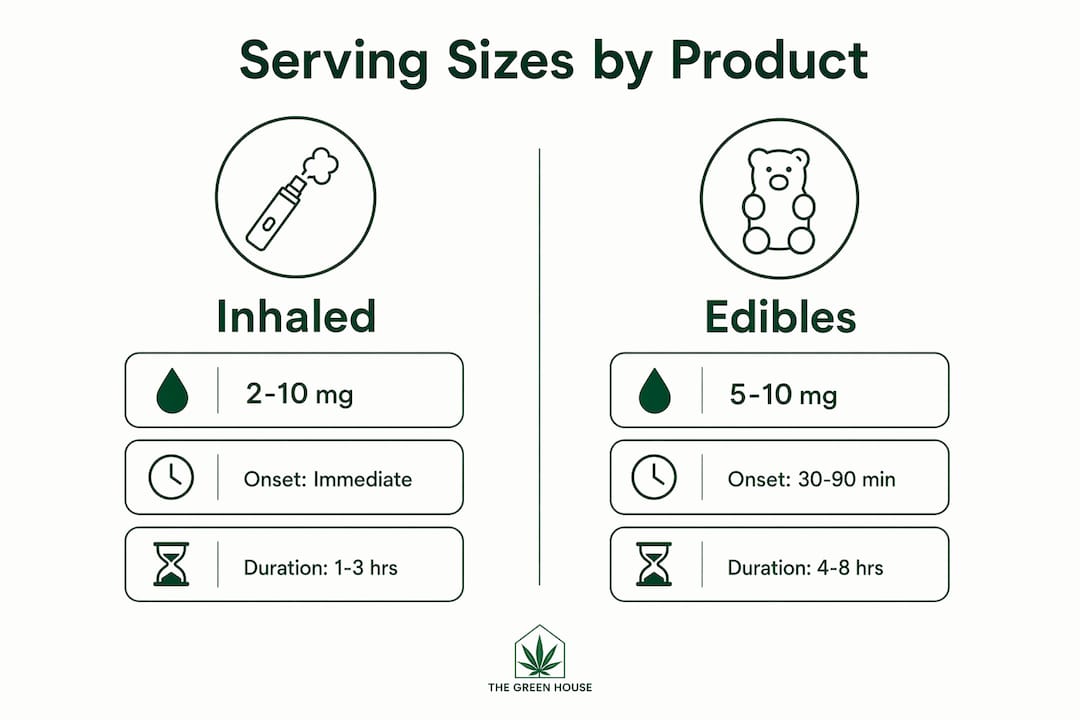
Inhalation onset is nearly immediate, which makes it easier to self-regulate. You feel the effect within minutes and can stop before going too far. Edibles are the opposite. The THC passes through your digestive system and liver before entering your bloodstream, which delays the peak effect by up to two hours or more.
That delay is where things go wrong. A consumer eats a 10 mg gummy, feels nothing after 45 minutes, and eats another. By the time both doses peak, they are dealing with 20 mg hitting at once. Matching inhalation dosing patterns to edibles causes most accidental overconsumption cases. The delivery method changes everything.
Tinctures sit in the middle. Held under the tongue, they absorb faster than edibles but slower than inhalation. They also allow for precise measurement in milligrams, making them a solid option for people who want control over their intake. If you are curious about the differences between THCA and CBD products, the THCA vs CBD breakdown at Tghhouston covers the key distinctions clearly.
Pro Tip: Never use your inhalation tolerance as a reference point for edible dosing. They are completely different systems. Treat every new product type as if you are starting from scratch.
Understanding regulatory limits on THC per serving and package
Regulatory serving size limits exist to create a consistent unit of measure, not to prescribe your personal dose. Knowing the rules in your region helps you read labels accurately and shop with confidence.
Here is how major U.S. states and Canada structure their limits:
| Jurisdiction | Max THC per serving | Max THC per package |
|---|---|---|
| Colorado | 10 mg | 100 mg |
| Washington | 10 mg | 100 mg |
| Massachusetts | 5.5 mg | 100 mg |
| Canada (Health Canada) | 10 mg | 1,000 mg (medical) |
The 100 mg per package cap in Colorado and Washington is a deliberate safety measure. It limits how much THC a single product can deliver, reducing the risk of extreme overconsumption from a single purchase.
Massachusetts lowered its per-serving cap to 5.5 mg specifically to make it easier for new consumers to start at a lower dose without having to cut products. That decision reflects growing awareness that 10 mg is too high a starting point for many people.
The critical consumer takeaway: a legal serving size is a label unit, not a dose recommendation. A product labeled as “1 serving = 10 mg” does not mean 10 mg is right for you. It means the manufacturer and regulator agreed on that as the standard unit. Your appropriate cannabis dose may be half that, or a quarter of that, especially if you are new.
Common dosing pitfalls and how to avoid them
Most bad cannabis experiences come from a small set of repeatable mistakes. Knowing them in advance puts you in a much stronger position.
-
Ignoring label inaccuracies. Only 17% of tested products meet within ±10% of their stated potency. That means a product labeled 10 mg could realistically contain 8 mg or 12 mg. Always start at the lowest recommended dose, regardless of what the label says.
-
Redosing too early with edibles. The most common mistake. If you do not feel anything after 60 minutes, wait another 60 minutes before considering more. Two hours is the minimum wait time for edibles.
-
Assuming higher THC means better results. Cannabis shows a biphasic dose-response: low doses reduce anxiety, while high doses can trigger it. More THC is not always more effective. It is often the opposite.
-
Copying a friend’s dose. Tolerance, body chemistry, and experience level vary enormously between people. What works for someone else may be too much or too little for you.
-
Skipping the Certificate of Analysis. Lab-tested products come with a COA that shows actual cannabinoid content. Checking the product COA at Tghhouston before you buy gives you real potency data, not just label estimates.
Pro Tip: If you buy edibles, use a pill cutter or sharp knife to divide them into smaller portions. A 10 mg gummy cut into four pieces gives you 2.5 mg servings, which is the ideal beginner starting point.
How to determine your appropriate cannabis serving size
Finding your personal ideal dose is a process, not a one-time decision. These steps give you a clear, repeatable method.
-
Choose your product and note the THC content per serving. Read the label and, if available, the COA. Know exactly what you are starting with.
-
Start at 1–2.5 mg THC. For a 10 mg gummy, that means cutting it into quarters. For a vape, that means one short puff.
-
Set a timer and wait. For edibles, wait a full two hours. For inhalables, wait 15–20 minutes. Do not take more before the timer goes off.
-
Record your experience. Note the dose, time, onset, intensity, and duration. This log becomes your personal cannabis dosage guide over time.
-
Increase gradually. If the previous session felt too mild, add 1–2.5 mg at your next session. Never double your dose in a single jump.
-
Account for variables. Tolerance builds with regular use. An ideal cannabis portion for a first-time user is very different from what a regular consumer needs. Revisit your baseline if you take a break of two or more weeks.
Factors like product potency, consumption method, and your own metabolism all shift your response. A diverse product collection also means different products require different baselines. Treat each new product type as a fresh starting point.
Key Takeaways
A cannabis serving size is a regulatory label unit, not a personal dose recommendation, and finding your ideal amount requires patient, gradual titration starting at 1–2.5 mg THC.
| Point | Details |
|---|---|
| Regulatory serving size | Most states set 10 mg THC per serving as the standard label unit, not a dose prescription. |
| Beginner starting dose | Start at 1–2.5 mg THC and wait at least two hours before considering more. |
| Method changes everything | Edibles take up to two hours to peak; inhalables act within minutes. Never cross-reference the two. |
| Label accuracy gap | Only 17% of products meet ±10% of stated potency, so always start low regardless of the label. |
| Biphasic THC effect | Low doses reduce anxiety; high doses can worsen it. More THC is not always better. |
Why serving size is the most misunderstood number in cannabis
Honestly, after watching people approach cannabis dosing for years, the biggest mistake I see is treating the serving size on the label as a target rather than a starting reference. A 10 mg gummy is not a recommendation. It is a unit of measure, like a tablespoon in a recipe. You would not eat a full tablespoon of hot sauce just because that is what the label calls a serving.
The regulatory serving size exists to create consistency in labeling, not to tell you what feels good. Individual response to THC varies more than most people expect. Two people can take the same 5 mg dose and have completely different experiences based on their metabolism, tolerance, and even what they ate that day.
What I find most interesting is the biphasic effect. The same compound that calms anxiety at 2.5 mg can trigger it at 15 mg. That is not a paradox. It is pharmacology. And it is the clearest argument for starting low and moving slowly. The people who have the worst experiences are almost always the ones who skipped the titration process entirely.
As cannabis laws evolve and more products hit the market, consumer education becomes the real differentiator. Reading a COA, understanding onset times by method, and keeping a dosing log are not complicated skills. They are just habits most people have not built yet. Build them early, and you will have a much better time.
— Ethan
Quality-dosed THCA products at Tghhouston
If you are ready to put these dosing principles into practice, Tghhouston makes it easy to start with products that have clear, lab-verified THC content.
The THCA Seltzer Single Cans are a great entry point. Each can is a single, individually dosed serving, so there is no cutting or guessing involved. For gummy fans, Wyld Gummies offer consistent, regulated THC content per piece, making them easy to divide for a beginner-friendly starting dose. Both products are lab-tested and available at Tghhouston’s EaDo and Spring Branch locations, open 24/7. Free delivery is available on orders over $100.
FAQ
What is a standard cannabis serving size?
A standard cannabis serving size is 5–10 mg of THC, as defined by most U.S. state regulators and Health Canada. This is a label unit for consistency, not a personal dose recommendation.
How much cannabis should a beginner take?
Beginners should start at 1–2.5 mg THC and wait at least two hours before taking more. This approach minimizes adverse effects and helps you find your personal effective dose safely.
Why do edibles feel stronger than smoking the same amount?
Edibles are metabolized through the liver, which converts THC into a more potent form and delays onset by 45 minutes to two hours. Inhalation acts within minutes, making it easier to control your intake in real time.
Can I trust the THC amount listed on a cannabis label?
Label accuracy varies significantly. Only 17% of tested products fall within ±10% of their stated potency. Always start at the lowest recommended dose and use products with a published Certificate of Analysis when possible.
What is the maximum safe daily THC amount?
Medical guidance suggests daily THC should not exceed 30 mg to avoid cognitive impairment, anxiety, and tolerance buildup. This ceiling applies to both medical and recreational consumers.
Recommended
Before You Go…
Here are a few handpicked articles to inspire your next self-care moment.


