

Cannabis Digital Receipt: What Every Buyer Should Know
A cannabis digital receipt is a mandatory electronic proof of purchase generated at the point of sale in licensed cannabis dispensaries. Unlike a standard retail receipt, this document captures detailed transaction data required by state regulators, including itemized taxes, product batch IDs, employee identifiers, and real-time inventory updates. Understanding what is a cannabis digital receipt matters because it directly connects your purchase to compliance, product authenticity, and consumer protection.
What is a cannabis digital receipt and why does it exist?
A cannabis digital receipt is defined as a mandatory electronic record generated at the point of sale to satisfy state compliance requirements. The New York Office of Cannabis Management, for example, requires this document to include dispensary information, itemized taxes, product form, and employee ID. That level of detail goes far beyond what you’d see on a coffee shop receipt.

The core purpose is regulatory accountability. Every licensed dispensary must prove that each sale followed the rules. A digital cannabis invoice creates that paper trail automatically. It also feeds data directly into state inventory systems, so regulators can verify that what was sold matches what was stocked.
Receipts shifted from simple proof of purchase to the heartbeat of dispensary compliance. Overlooking them risks regulatory penalties that can threaten a dispensary’s license. For you as a consumer, this means your receipt is a live compliance document, not just a transaction summary.
What information must a cannabis digital receipt contain?
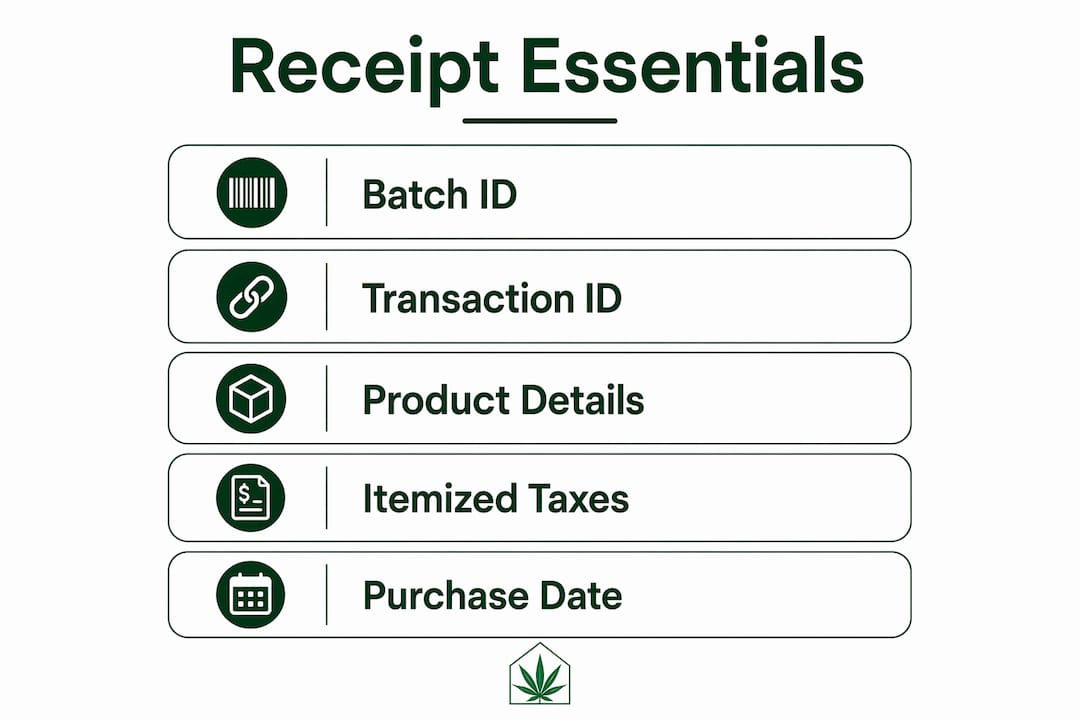
The required fields on a cannabis digital receipt go well beyond product name and price. Regulators mandate specific data points to protect both the consumer and the dispensary. Here’s what a compliant receipt must include:
- Dispensary name, license number, and address so the sale is tied to a specific licensed location
- Employee ID or budtender identifier for traceability in case of a compliance audit
- Product type, strain, and form (flower, vape, edible) so the product category is clear
- Batch ID and lot number linking the product to its lab test results
- Quantity purchased and unit weight or count
- Purchase timestamp recording the exact date and time of the transaction
- Itemized tax breakdown showing state excise, local cannabis tax, and standard sales tax as separate line items
- Age verification confirmation and purchase limit check, as mandated by state law
- Unique transaction ID for record matching with state systems
Each of these fields serves a specific compliance function. The batch ID, for instance, lets regulators trace a product back to its cultivation source if a safety issue arises. The employee ID creates accountability at the individual level.
Pro Tip: Save your digital receipt immediately after purchase. If you ever need to verify a return or dispute a charge, the unique transaction ID and batch ID are the two most useful fields. Tghhouston’s refund policy outlines exactly what documentation you’ll need.
How do cannabis receipts handle multi-layered taxation?
Cannabis taxation is genuinely complex, and your digital receipt reflects that complexity in full. Most states apply a tax-on-tax structure where the state excise tax is calculated first, and then standard sales tax is applied on top of the already-taxed price. That’s why cannabis purchases often feel more expensive than the shelf price suggests.
The variation by state and city is significant. Illinois uses a tiered excise tax ranging from 10% to 25% based on THC content. Los Angeles adds a 10% city cannabis tax on top of California’s state excise and sales taxes. A single purchase in LA can carry three or four separate tax line items on the receipt.
Here’s a breakdown of the typical tax categories you’ll see on a compliant cannabis receipt:
| Tax Category | Who Collects It | Typical Range |
|---|---|---|
| State excise tax | State government | 10%–37% depending on state |
| Local cannabis tax | City or county | 0%–15% |
| Standard sales tax | State and local | 6%–10% |
| Cultivation tax | State (some states) | Per-ounce flat fee |
Each line item on your receipt represents a real payment to a specific government entity. Seeing them separated out is not just transparency. It’s a legal requirement.
Pro Tip: If your receipt shows a single lump “tax” line instead of itemized categories, that’s a red flag. A compliant dispensary always breaks taxes out individually. Cross-reference your receipt against your state’s published cannabis tax rates to confirm accuracy.
How does the technology behind digital receipts work?
Cannabis point-of-sale systems do more than print a receipt. They connect directly to state inventory tracking platforms. The two dominant systems are Metrc and BioTrack, and real-time reporting to one of these platforms is mandatory in most regulated states. Batch uploads or delayed reporting are not acceptable under current compliance standards.
Here’s what happens in the background when you complete a purchase:
- The POS system records the transaction and assigns a unique transaction ID
- Product batch data is pulled from the dispensary’s inventory and matched to your purchase
- Tax calculations run automatically based on product type, THC content, and location
- The transaction syncs in real time with the state’s Metrc or BioTrack database
- Your receipt is generated and delivered via email or SMS, or printed on request
On the B2B side, automated payment tools save dispensaries 30+ hours weekly and enable fully compliant bank-to-bank payments. That efficiency reduces the inventory discrepancies that can trigger audits. Digital invoicing also integrates with accounting tools like QuickBooks, making financial reconciliation far cleaner than cash-based systems.
For consumers, the practical benefit is convenience and confidence. You receive your cannabis purchase confirmation via email or SMS within seconds. You have a permanent record of what you bought, when, and from whom. That record is useful for returns, for verifying lab test results through batch IDs and COAs, and for confirming that the dispensary operates legally.
Digital receipts also save mid-sized dispensaries $500–$1,000 annually in paper costs. That saving is minor compared to the risk they eliminate. Non-compliance fines can exceed $50,000, and a single audit failure can cost a dispensary its license.
How to read and use your cannabis digital receipt as a consumer
Your digital receipt is more useful than most people realize. Knowing how to read it turns a routine document into a verification tool. Here’s a step-by-step approach:
-
Locate the batch ID. This number links your product to its specific production run. You can use it to pull the Certificate of Analysis (COA) and confirm the lab test results for potency and contaminants.
-
Check the unique transaction ID. This code matches your purchase to the dispensary’s records and the state’s inventory system. Keep it for any return or dispute.
-
Review the itemized tax breakdown. Confirm that state excise, local cannabis tax, and sales tax appear as separate line items. A missing or combined tax line may indicate a compliance issue.
-
Verify the employee ID. A compliant receipt always includes a staff identifier. Its presence confirms the sale was logged under a licensed employee.
-
Confirm the purchase timestamp. The date and time of your transaction should match your memory of the visit. Discrepancies can indicate a data entry error worth flagging.
-
Check for age verification and purchase limit notes. State law requires these confirmations to appear on the receipt. Their absence is a compliance gap.
The absence of batch IDs or itemized tax breakdowns may indicate poor inventory management or non-compliance. That’s a signal worth taking seriously. A receipt missing these details is not just incomplete. It’s a sign the dispensary may not be operating to standard.
Key Takeaways
A cannabis digital receipt is the single most important compliance document in a regulated cannabis transaction, capturing real-time data that protects both the consumer and the dispensary’s license.
| Point | Details |
|---|---|
| Definition and purpose | A cannabis digital receipt is a mandatory electronic record proving purchase compliance, not just a transaction summary. |
| Required fields | Batch IDs, employee IDs, itemized taxes, and a unique transaction ID are all legally required on compliant receipts. |
| Tax complexity | Multi-layered taxes including state excise, local cannabis tax, and sales tax must appear as separate line items. |
| Real-time tech integration | Receipts sync instantly with state systems like Metrc and BioTrack, making delayed reporting a compliance violation. |
| Consumer verification | Checking batch IDs and itemized taxes on your receipt confirms product authenticity and dispensary compliance. |
Why digital receipts changed how I think about cannabis retail
I’ve spent a lot of time around cannabis retail operations, and the shift to digital receipts is one of the most underappreciated changes in the industry. Most consumers glance at the total, pocket the receipt, and move on. That’s a missed opportunity.
The digital receipt is now a dynamic entity in cannabis compliance ecosystems. Real-time data submission is mandatory, and that changes everything about how a dispensary operates. A dispensary that gets this right is running a tight, professional operation. One that doesn’t is one audit away from serious trouble.
What I find genuinely interesting is how much the receipt tells you about the dispensary’s overall quality. If the batch IDs are there, the taxes are itemized, and the employee ID is present, that dispensary is doing the work. They’re not cutting corners on compliance, which usually means they’re not cutting corners on product quality either.
Consumers should expect detailed digital receipts as a baseline standard, not a bonus feature. If your dispensary can’t produce a receipt with itemized taxes and a batch ID, ask why. The answer will tell you a lot about how seriously they take their license and your safety.
The shift from paper to digital isn’t just about saving trees or cutting costs. It’s about creating a real-time, auditable record that protects everyone in the transaction. That’s the kind of transparency that builds lasting trust between dispensaries and their customers.
— Ethan
Tghhouston makes compliant cannabis purchasing easy
At Tghhouston, every purchase comes with a fully compliant digital receipt that includes itemized taxes, batch IDs, and real-time inventory tracking. We operate two 24/7 THCA dispensaries in Houston, and our commitment to transparency means you always know exactly what you’re buying and what you’re paying.

Our products are lab-tested, clearly labeled, and traceable from cultivation to your hands. If you want to experience what compliant, transparent cannabis retail looks like in practice, check out our THCA Seltzer Single Cans. Every order over $100 ships free, and your digital purchase confirmation arrives instantly. That’s the Tghhouston standard.
FAQ
What is a cannabis digital receipt?
A cannabis digital receipt is a mandatory electronic proof of purchase generated at the point of sale in a licensed dispensary. It includes itemized taxes, batch IDs, employee identifiers, and real-time data synced to state inventory systems like Metrc or BioTrack.
Why does my cannabis receipt show so many tax lines?
Cannabis purchases are subject to multi-layered taxation including state excise tax, local cannabis tax, and standard sales tax, all of which must appear as separate line items. States like Illinois and cities like Los Angeles add their own cannabis-specific taxes on top of standard rates.
How do I verify my cannabis purchase is legitimate using my receipt?
Check your receipt for a batch ID, unique transaction ID, and itemized tax breakdown. The batch ID links your product to its lab test results, and the transaction ID matches your purchase to the state’s inventory records.
What happens if my cannabis receipt is missing a batch ID?
A missing batch ID may indicate poor inventory management or non-compliance with state regulations. Compliant dispensaries are required to include batch-level data on every receipt to support product traceability and audit readiness.
Can I use my cannabis digital receipt for a return?
Yes. Your unique transaction ID and batch ID are the key fields needed to process a return or dispute a charge. Keep your digital receipt saved in your email or SMS history for easy access.
Recommended
Before You Go…
Here are a few handpicked articles to inspire your next self-care moment.


