

Cannabis Certificate Analysis: What You Need to Know
A cannabis Certificate of Analysis (CoA) is an official lab test report that verifies the safety, potency, and quality of a cannabis product before it reaches you. Understanding what is cannabis certificate analysis means knowing how to read this document, what each section tells you, and why it matters for your health. Regulated markets like New Jersey require a CoA for every product sold legally. Whether you’re a consumer picking up THCA flower or a dispensary professional approving a batch for retail, the CoA is your single most reliable quality signal.
What is cannabis certificate analysis and what does it include?
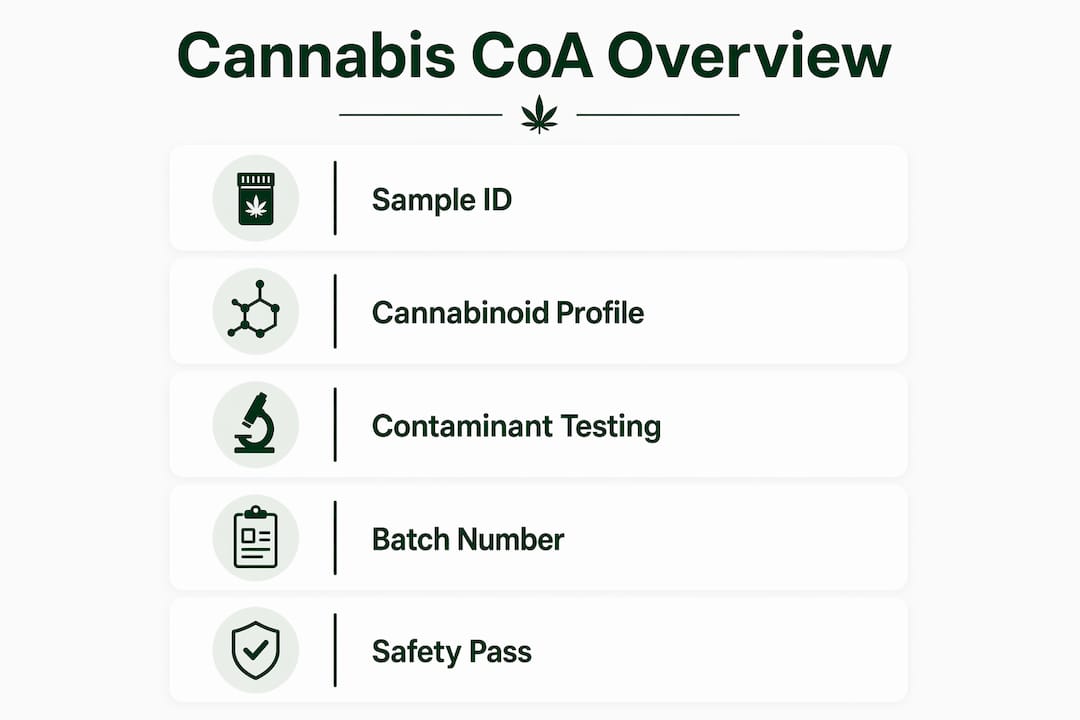
A cannabis CoA is a structured lab report divided into distinct sections, each covering a different aspect of product quality. The New Jersey Cannabis Regulatory Commission breaks CoAs into product identification, cannabinoid potency, and contaminant testing panels. That structure is consistent across most regulated markets, which makes learning to read one CoA useful everywhere.
Product and sample identification
Every CoA starts with header information: the batch or lot number, sampling date, lab ID, and product name. These fields are not just administrative details. Regulated workflows treat batch IDs as gating criteria. If the batch number on the CoA does not match the number on your product packaging, the entire document is unreliable for that product.
Cannabinoid profile
The cannabinoid section lists THC, THCA, CBD, CBDA, and often CBG and CBN. THC and THCA are the primary focus for psychoactivity, while CBD and its acid form are non-psychoactive. Terpene profiles may also appear here, labeled separately, giving you insight into flavor and aroma. Understanding cannabinoid differences like THC vs. THCA helps you interpret these numbers accurately.
Contaminant testing panels
This is the section that protects your health. Contaminant panels cover:
- Microbiological hazards: mold, yeast, E. coli, Salmonella
- Heavy metals: lead, arsenic, cadmium, mercury
- Pesticides: residues from cultivation chemicals
- Residual solvents: leftover extraction chemicals in concentrates and vapes
- Mycotoxins: toxic compounds from mold, tested primarily on flower
- Foreign materials: physical contaminants like glass or insect parts
Each panel shows a pass or fail result. A pass means the product meets the safety threshold set by the regulating authority. A fail means it does not, and the batch should not be sold.
Pro Tip: Always scroll past the cannabinoid numbers and check every contaminant panel. A product with impressive THC percentages but a missing pesticide panel is not a safe product.
How to read and interpret cannabis lab results accurately
Reading a CoA well takes a few minutes and a clear process. Here’s a reliable workflow:
-
Verify the batch number first. Match the lot or batch number on the CoA to the number printed on your product. Mismatched batch numbers invalidate the CoA’s usefulness entirely. This step takes ten seconds and filters out fraudulent or misapplied documents immediately.
-
Check the test date. A CoA older than 12 months may not reflect the current product batch. Freshness matters for both safety and potency accuracy.
-
Read the pass/fail column in contaminant panels. Pass designations are the clearest consumer signal of product safety. Every required panel should show “pass.” A blank or missing panel is a red flag, not a neutral result.
-
Calculate Total THC. Labs report THCA and THC separately. Total THC is calculated as (THCA × 0.877) + THC to reflect the potency after decarboxylation, which is what happens when you heat the product. This number is what matters for dosing.
-
Confirm lab accreditation. Labs accredited to ISO/IEC 17025 standards deliver reliable, independently verified results. An unaccredited lab may produce inconsistent data. Look for the accreditation number or logo on the CoA header.
-
Verify all required panels are present. Quality assurance best practices require cross-checking that every panel required for the product type is included and shows acceptable results. A CoA missing a pesticide panel for flower is incomplete, regardless of what the cannabinoid numbers say.
Pro Tip: Screenshot or save the CoA alongside your purchase receipt. If you ever have a reaction or quality concern, the batch number gives you a direct trail back to the lab and the producer.
Why cannabis testing matters for safety and quality assurance
The core value of a cannabis CoA is not the THC percentage. It is the comprehensive safety verification through contaminant testing. Cannabinoid potency tells you how strong a product is. Contaminant panels tell you whether it is safe to consume at all.
Here is what a complete CoA protects you from:
- Mold and bacteria: Cannabis flower can harbor Aspergillus and other pathogens dangerous to people with compromised immune systems.
- Pesticides: Residues from cultivation chemicals concentrate during extraction, making untested concentrates particularly risky.
- Heavy metals: Soil contamination can introduce lead or arsenic into flower and extracts at harmful levels.
- Residual solvents: Butane, propane, and ethanol used in extraction must fall below safety thresholds in vapes and concentrates.
- Mislabeled potency: A product labeled 25% THC but testing at 15% is a consumer protection issue. CoAs prevent that gap.
A CoA also functions as a compliance record used to determine whether a batch is fit for retail release. Dispensaries and producers use it as a quality assurance checkpoint before any product moves to shelves. This makes the cannabis certification process a shared responsibility across labs, producers, and retailers.
Public trust in cannabis products depends on this transparency. When consumers can access a CoA for every product they buy, the entire market becomes more accountable.
How CoA requirements differ by product type and region
Not every product needs the same testing panels. The cannabis certification process varies based on what the product is and where it is sold.
| Product type | Required panels | Notes |
|---|---|---|
| Flower | Cannabinoids, microbials, heavy metals, pesticides, mycotoxins, moisture, water activity | Moisture and water activity prevent mold growth and degradation |
| Extracts and concentrates | Cannabinoids, microbials, heavy metals, pesticides, residual solvents | Solvent testing is mandatory; moisture testing is not typically required |
| Vapes and disposables | Cannabinoids, microbials, heavy metals, pesticides, residual solvents | Residual solvent thresholds are stricter due to inhalation risk |
| Edibles and gummies | Cannabinoids, microbials, heavy metals, pesticides | Homogeneity testing may also be required to confirm even dosing |
Regional rules add another layer. New Jersey’s Cannabis Regulatory Commission specifies which panels are mandatory for each product category. Health Canada applies its own testing framework under the Cannabis Act, with different action limits for contaminants. A CoA that passes in one jurisdiction may not meet the standards of another. Consumers and professionals working across state or national lines need to verify which local requirements apply to each product they handle.
Pro Tip: If you buy THCA vapes or concentrates, always confirm the residual solvent panel is present and shows a pass. This panel is non-negotiable for inhalable products.
Key Takeaways
A cannabis CoA is only as useful as your ability to read it correctly. Batch verification, contaminant panel review, and lab accreditation checks are the three steps that separate informed consumers from those relying on marketing alone.
| Point | Details |
|---|---|
| CoA definition | A CoA is a third-party lab report confirming safety, potency, and quality for every regulated cannabis product. |
| Batch number verification | Always match the CoA batch number to your product packaging before trusting any test result. |
| Contaminant panels first | Pass results across all contaminant panels matter more than cannabinoid percentages for consumer safety. |
| Total THC formula | Total THC equals (THCA × 0.877) + THC, reflecting actual potency after heating. |
| Product-specific panels | Flower requires moisture and mycotoxin testing; vapes and extracts require residual solvent testing. |
Why I think most people read CoAs backwards
I’ve spent years watching both consumers and industry professionals open a CoA, scroll straight to the THC number, and close the document. Honestly, that’s the least useful thing you can do with it.
The cannabinoid profile tells you how strong a product is. The contaminant panels tell you whether it is safe. Those are not equal priorities. A product with 30% THC and a failed pesticide panel is a health risk. A product with 18% THC and clean passes across every panel is a safe, quality product. The number that matters most is the one most people skip.
The second mistake I see constantly is ignoring the batch number. I’ve seen CoAs circulated online that were attached to products they were never tested for. The batch ID is the only thing connecting the document to the actual product in your hand. Without that match, the CoA is just a piece of paper.
My practical recommendation: build a simple three-step habit. Check the batch number. Scan every contaminant panel for passes. Then look at the cannabinoid numbers. That order protects you. The reverse order just flatters you.
The future of CoA access is moving toward QR codes on packaging that link directly to the lab report. Some producers already do this. When that becomes standard, reading cannabis lab results will get much easier for everyday consumers. Until then, knowing how to find and verify a CoA yourself is the most practical skill you can develop as a cannabis buyer.
— Ethan
Lab-tested products you can trust at Tghhouston
At Tghhouston, every product on our shelves comes with a verified CoA you can actually access. We don’t just say our products are lab-tested. We make those results available so you can check for yourself.

Whether you’re picking up Wyld Gummies or grabbing a THCA seltzer for a chill night, you can review the full lab results before you buy. Our product COAs are posted and updated with every new batch. Both our EaDo and Spring Branch locations are open 24/7, and our online store offers free delivery on orders over $100. Quality you can verify, any time you want it.
FAQ
What is a cannabis certificate of analysis?
A cannabis Certificate of Analysis (CoA) is a lab test report that confirms a product’s cannabinoid potency, safety from contaminants, and overall quality. It is required for legal cannabis sales in regulated markets.
How do I read the cannabinoid section of a CoA?
Look for THC, THCA, CBD, and CBDA percentages. Total THC is calculated as (THCA × 0.877) + THC to reflect potency after the product is heated.
What does a “pass” mean on a cannabis CoA?
A pass means the product tested below the safety threshold set by the regulating authority for that contaminant. Every panel should show a pass before a product is considered safe for sale or consumption.
Why does the batch number on a CoA matter?
The batch number links the lab report to a specific production run. A mismatched or missing batch number means the CoA cannot be reliably applied to the product you are holding.
Do all cannabis products require the same CoA tests?
No. Flower requires moisture, water activity, and mycotoxin testing. Vapes and extracts require residual solvent testing. Edibles may require homogeneity testing. Requirements also vary by state and country.
Recommended
Before You Go…
Here are a few handpicked articles to inspire your next self-care moment.


