

What Is Non Psychoactive Cannabis? A Clear Guide
Non-psychoactive cannabis is defined as hemp-derived cannabis containing no more than 0.3% Delta-9-THC by dry weight, which means it produces no intoxicating effects. The industry term for these products is “non-intoxicating cannabis,” and both terms refer to the same category. Cannabidiol (CBD) is the most recognized compound in this group, but over 113 distinct phytocannabinoids have been identified in the cannabis plant, many of them non-intoxicating. If you’ve been curious about cannabis without THC for health and wellness purposes, this guide breaks down exactly what you need to know.
What is non psychoactive cannabis, and how is it defined?
Non-intoxicating cannabis products come from hemp plants bred to stay at or below the federal 0.3% THC threshold. That legal limit, established under the 2018 Farm Bill and recognized by federal agencies including the CDC and NIH, is what separates hemp from marijuana under U.S. law. Cross that line, and a product is legally classified as marijuana regardless of how it’s marketed.
The 0.3% THC ceiling is not arbitrary. At that concentration, Delta-9-THC does not produce the receptor activation in the brain needed to cause a high. Products within this range can contain a full spectrum of other cannabinoids, terpenes, and plant compounds without triggering intoxication.
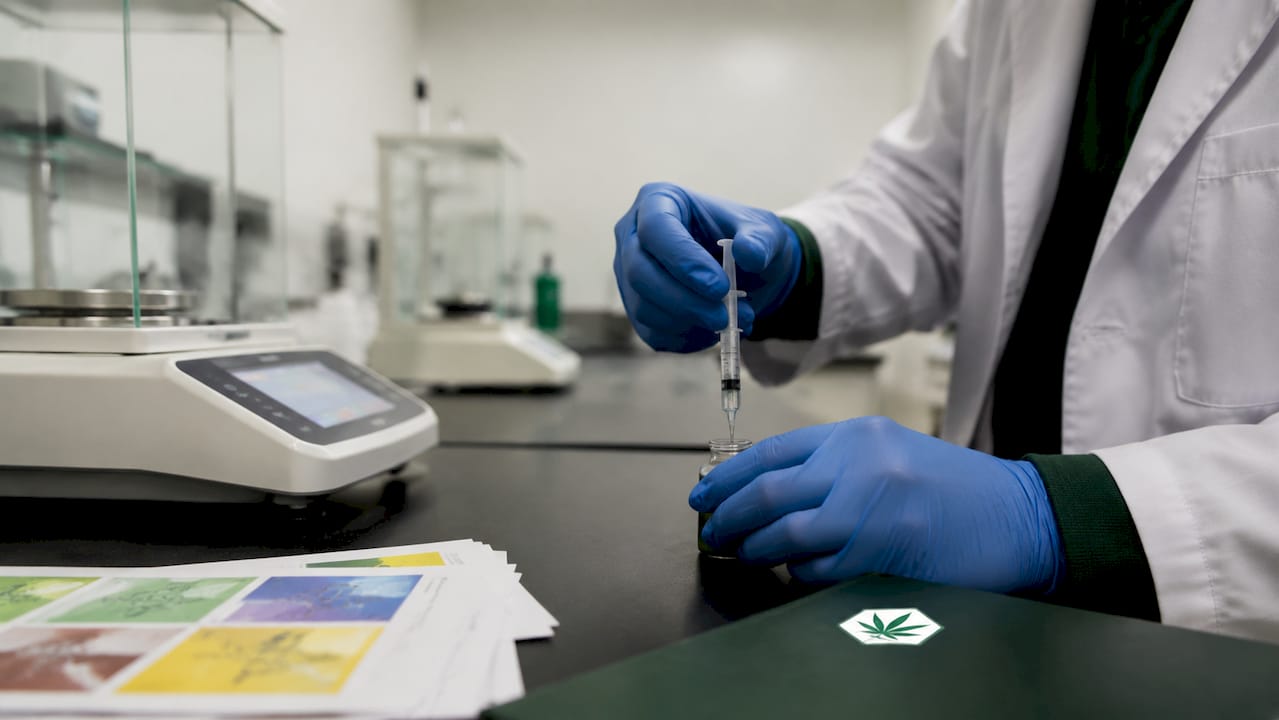
This distinction matters practically. A hemp-derived CBD tincture, a CBG capsule, and a CBC topical all qualify as non-intoxicating cannabis products. A high-THC flower, even if it’s marketed as “wellness-focused,” does not. Knowing where the line sits helps you shop with confidence.
What are cannabinoids, and which ones are non-intoxicating?
Cannabinoids are chemical compounds produced by the cannabis plant that interact with the body’s endocannabinoid system. Some activate the CB1 receptor in the brain and produce a high. Others do not, and those are the ones we’re focused on here.
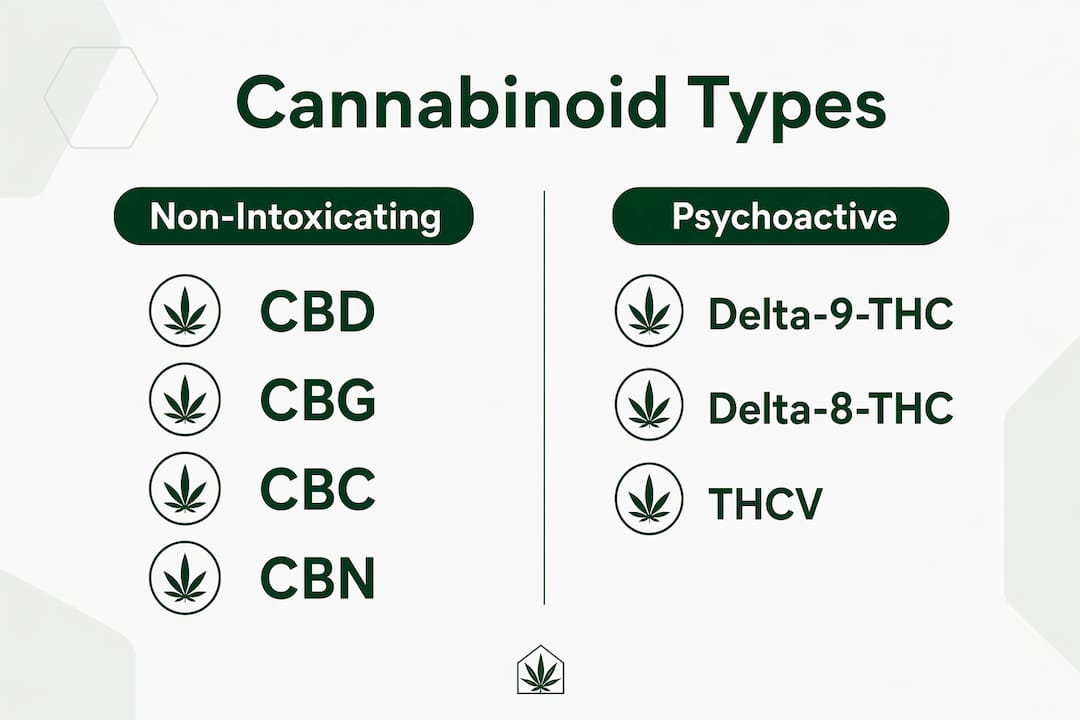
The four major non-intoxicating cannabinoids are:
- CBD (Cannabidiol): The most studied non-intoxicating cannabinoid. CBD does not bind to CB1 receptors the way THC does, which is why it produces no high. It’s found in hemp flower, oils, gummies, and topicals.
- CBG (Cannabigerol): Often called the “mother cannabinoid” because other cannabinoids synthesize from it. CBG is non-intoxicating and is being studied for its potential effects on inflammation and mood.
- CBC (Cannabichromene): A lesser-known cannabinoid that does not produce intoxication. Early research points to possible anti-inflammatory and neuroprotective properties.
- CBN (Cannabinol): A mildly sedating but non-intoxicating compound that forms as THC ages and breaks down. Many people use CBN products specifically for sleep support.
Beyond these four, researchers have identified more than 113 distinct phytocannabinoids in the cannabis plant. That number signals just how much we’re still learning about what hemp can do.
Pro Tip: If you want the benefits of multiple cannabinoids without intoxication, look for a full-spectrum hemp product with a verified certificate of analysis showing THC below 0.3%.
How does non-intoxicating cannabis differ from psychoactive cannabis?
The core difference is receptor binding. THC binds directly to CB1 receptors in the brain, triggering the cascade of effects people call a “high.” CBD, CBG, CBC, and CBN do not bind to CB1 receptors in the same way. That single biochemical difference is what separates intoxicating from non-intoxicating cannabis.
Here’s a side-by-side look at the key differences:
| Feature | Psychoactive cannabis | Non-intoxicating cannabis |
|---|---|---|
| THC content | Above 0.3% Delta-9-THC | At or below 0.3% Delta-9-THC |
| CB1 receptor activation | Yes, causes intoxication | No, no high produced |
| Legal status (federal) | Controlled substance | Legal under 2018 Farm Bill |
| Primary cannabinoids | THC-dominant | CBD, CBG, CBC, CBN |
| Drug test risk | High | Low but possible with trace THC |
One thing worth flagging: trace THC in hemp products can still trigger a positive drug test, even when the product is legally non-intoxicating. The THC level is too low to impair you, but sensitive drug screenings can detect it. If you’re subject to workplace drug testing, that’s a real consideration.
Legal complexity also plays a role. Hemp-derived products are federally legal, but state laws vary. Some states have additional restrictions on specific cannabinoids like Delta-8-THC, which occupies a gray area between non-intoxicating and psychoactive. Always check your state’s current rules before purchasing.
Pro Tip: Ask for the certificate of analysis before you buy any hemp product. A reputable brand will always have one available.
What are the benefits and uses of non-intoxicating cannabis?
The wellness applications of non-intoxicating cannabinoids are broad, and the research is growing fast. Here are the most well-supported uses:
-
Pain and inflammation relief. CBD and CBG both interact with pathways involved in pain signaling and inflammation. People use these cannabinoids for chronic pain, muscle soreness, and joint discomfort without the impairment that comes with THC.
-
Sleep support. CBN is the standout here. As a breakdown product of THC, it retains mild sedating properties without intoxication. Many people report better sleep quality with CBN-containing products, particularly when combined with CBD.
-
Anxiety and stress reduction. CBD’s interaction with serotonin receptors is one of the most studied mechanisms in cannabinoid research. While the FDA has not approved CBD for anxiety disorders, consumer reports and early clinical data consistently point to calming effects.
-
Anti-inflammatory applications. Research on cannabinoid-free hemp varieties shows that even non-cannabinoid compounds in hemp, like flavonoids and phenolics, carry antioxidant and anti-inflammatory properties. This suggests the whole plant offers more than any single compound.
-
Skin and topical use. CBD and CBC are increasingly found in topical formulations targeting localized inflammation, acne, and skin barrier support. Topicals don’t enter the bloodstream in meaningful amounts, making them a low-risk entry point for new users.
Product format matters as much as cannabinoid choice. Full-spectrum products contain multiple cannabinoids and terpenes that work together through what researchers call the “entourage effect.” Isolates, by contrast, deliver a single cannabinoid at very high purity. CBD isolate can exceed 99% purity, making it useful for people who need precise dosing or want to avoid even trace THC.
The entourage effect is worth understanding. Non-intoxicating cannabinoids interact with terpenes to create subtle sensory effects, like mild relaxation or a sense of calm, that some people mistake for intoxication. They are not. These are non-psychoactive experiences produced by the plant’s natural chemistry working together.
What should you know about safety, regulation, and product quality?
The non-intoxicating cannabis market is not uniformly regulated, and that creates real risks for consumers. The FDA has approved only one CBD-based drug (Epidiolex, for specific seizure disorders) and has not approved CBD as a dietary supplement or food additive. That regulatory gap means product quality varies widely.
Key safety considerations every consumer should know:
- Mislabeling is common. Public health advisories stress that many CBD-labeled products contain varying levels of THC and contaminants. A product labeled “THC-free” may still contain detectable amounts.
- Synthetic cannabinoids are a separate risk. The CDC has issued health alerts about synthetic cannabinoids, which are chemically distinct from plant-derived cannabinoids and carry significantly higher risk profiles. Delta-8-THC, while hemp-derived, is often produced through chemical synthesis from CBD and sits in a different regulatory category.
- Contaminants matter. Hemp is a bioaccumulator, meaning it absorbs heavy metals and pesticides from soil. Products without third-party lab testing may carry these contaminants.
- Dosing is not standardized. Without FDA oversight of most hemp products, serving sizes and cannabinoid concentrations are not held to a consistent standard across brands.
Pro Tip: Always look for products with a scannable QR code linking to a third-party lab report. That report should show cannabinoid potency, residual solvents, heavy metals, and pesticide results.
The safest path is buying from brands that publish full lab results, clearly state their cannabinoid concentrations, and source hemp from licensed U.S. farms. Understanding how cannabis cultivars differ also helps you choose products bred specifically for low THC and high non-intoxicating cannabinoid content.
Key Takeaways
Non-intoxicating cannabis is defined by its THC content at or below 0.3%, its non-binding relationship with CB1 receptors, and its broad wellness applications across CBD, CBG, CBC, and CBN.
| Point | Details |
|---|---|
| Legal THC threshold | Hemp must contain 0.3% or less Delta-9-THC to be federally legal and non-intoxicating. |
| CB1 receptor binding | Non-intoxicating cannabinoids do not activate CB1 receptors, which is why they produce no high. |
| Drug test risk | Trace THC in legal hemp products can still trigger a positive drug test despite no impairment. |
| Product format matters | Full-spectrum products offer the entourage effect; isolates offer higher purity and precise dosing. |
| Lab testing is non-negotiable | Always verify a certificate of analysis before purchasing any hemp-derived product. |
What I’ve learned from watching the non-intoxicating cannabis market grow
The biggest misconception I see is that “non-psychoactive” means “completely inert.” People expect nothing to happen, then feel mild relaxation from a CBD and terpene combination and assume they got something wrong. They didn’t. That subtle shift in how you feel is the entourage effect doing exactly what it’s supposed to do. It’s not a high. It’s the plant’s chemistry working.
The second misconception is that all non-intoxicating products are the same. They’re not. A CBN sleep gummy and a CBG focus capsule are targeting completely different systems in your body. Treating them as interchangeable is like treating ibuprofen and melatonin as the same because neither gets you high. Cannabinoid profiles matter, and the brands that publish clear ones are the ones worth trusting.
Honestly, the market hype around CBD has made it harder for people to find accurate information. Every brand claims their product is the most pure, the most potent, the most effective. The only way to cut through that noise is to read the lab report. If a brand won’t show you one, that tells you everything you need to know.
My advice: start with a single cannabinoid product from a brand with transparent lab results. Learn how your body responds. Then experiment with full-spectrum options if you want to explore the entourage effect. And if you’re on any medications or have a health condition, talk to your doctor before adding cannabinoids to your routine. The science is promising, but it’s not a substitute for professional medical guidance.
— Ethan
Quality non-intoxicating cannabis products at The Greenhouse Dispensary
If you’re ready to try non-intoxicating cannabis for yourself, The Greenhouse Dispensary makes it easy to find lab-tested options that fit your wellness goals.
The Greenhouse Dispensary carries a rotating selection of hemp-derived products, including Wyld Gummies for a clean, consistent CBD experience and high-potency gummy options for those who want more from their cannabinoid routine. Every product on the shelf meets strict quality standards, and lab results are available so you always know what you’re getting. With free delivery on orders over $100 and 24/7 access at both Houston locations, getting started has never been more straightforward.
FAQ
What is non psychoactive cannabis in simple terms?
Non-psychoactive cannabis is hemp-derived cannabis that contains 0.3% or less Delta-9-THC, the compound responsible for intoxication. It does not produce a high because its cannabinoids do not activate CB1 receptors in the brain.
Is CBD the only non-intoxicating cannabinoid?
No. CBD is the most well-known, but CBG, CBC, and CBN are also classified as non-intoxicating cannabinoids. Researchers have identified over 113 distinct phytocannabinoids in the cannabis plant, many of them non-psychoactive.
Can non-intoxicating cannabis products cause a failed drug test?
Yes, they can. Legal hemp products contain up to 0.3% THC, and sensitive drug screenings can detect trace amounts even when no impairment is present. If drug testing is a concern, consider a CBD isolate product verified as THC-free by a third-party lab.
What is the difference between full-spectrum and isolate non-intoxicating products?
Full-spectrum products contain multiple cannabinoids and terpenes that work together through the entourage effect. Isolates contain a single cannabinoid, often at purity levels above 99%, and are better suited for people who need precise dosing or want to avoid trace THC entirely.
How do I know if a non-intoxicating cannabis product is safe?
Look for a certificate of analysis from a third-party lab that shows cannabinoid potency, heavy metals, pesticides, and residual solvents. Reputable brands make this document easy to find, either on their website or via a QR code on the packaging.
Recommended
Before You Go…
Here are a few handpicked articles to inspire your next self-care moment.


